
Developmental Orientation and Mobility
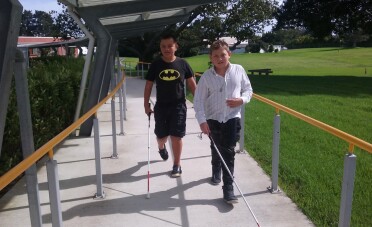
Developmental Orientation and Mobility builds body awareness for ākonga who are blind, deafblind, or have low vision, strengthening spatial understanding through movement, integration, enabling navigation.
Description/Purpose
Developmental Orientation and Mobility (DOM) for ākonga who are blind, deafblind, or have low vision emphasises the importance of body and self-awareness as the foundation for intentional movement. As ākonga develop these skills, their understanding of spatial concepts and the world grows. Movement skills evolve through exposure to various environments and regular practice, integrating sensory information to build confidence and independence. Participation and inclusion fosters capability, enabling ākonga to navigate safely and confidently. Repeated experiences, and the use of diverse skills, and tools are crucial for making informed choices about movement and travel.
What ākonga will understand, know and do across their learning pathways
Understand – Big Ideas
As ākonga build Developmental Orientation and Mobility capabilities and knowledge, they will come to understand that:
- Having body and self-awareness are fundamental and foundational to intentional movement. This will evolve over time and through planned and meaningful learning experiences.
The ability to engage in purposeful movement increases as body and self-awareness develop.
Understanding of the world grows as concepts and awareness of space develop.
- Developing movement skills is an ongoing process which continually evolves.
- Purposeful movement skills develop and change over time through exposure to various everyday environments. These are refined with regular practice.
- Using senses to gain and experience new information will be a motivation to connect with the world.
Experience of the world starts with self and expands to the immediate environment, whānau, community, and beyond. Information gained through the senses contributes to understanding and connection to the world.
- Having confidence in the ability to move and navigate the environment will help ākonga to actively participate and be included within communities.
- Capability and confidence are built through participation and inclusion.
- The ability to move, strengthens self-belief and confidence to navigate the environment safely. Capability is built through incremental and repetitive skill development. As movement becomes more intentional and independent, the capacity to navigate improves.
Know – Content and Concepts
As ākonga develop communication capabilities and knowledge, they come to know that:
- Communication occurs in a variety of ways.
- Inclusive communication may be verbal and non-verbal. Communication may include facial expressions, body movement, gestures, signs, talking, listening, reading, and writing.
- Accessible communication for blind, deafblind and low vision communities includes a wide range of formats.
- Braille, audible, large print, and tactile formats provide greater access to information, increasing participation in learning and life.
- Communication is reciprocal.
- Communication involves sharing information, ideas, and feelings with others. Respect and openness to each other’s ideas and feelings build trust and encourage honest communication.
- Communication will change in different situations.
- Communication will vary depending on social and cultural settings, and audience. Different approaches and skills are needed to understand others and be understood.
Do – Practices
As ākonga develop developmental orientation and mobility capabilities and knowledge they will be able to:
- Use and understand the language connected to key concepts and apply a range of problem-solving skills to safely navigate different environments.
- By experiencing repeated opportunities to develop body, physical, and spatial concepts, ākonga will deepen their capabilities and knowledge.
- Safely navigate different environments.
- For ākonga to make informed choices about safely navigating different environments, repeated experiences using a variety of skills, tools and technologies are needed.
- Confidently make choices about approaches and tools to safely navigate and travel within and across multiple settings
- The ability to generalise and apply orientation and mobility concepts and skills across multiple and repeated experiences will build confidence to make informed choices.
Teaching Guidance
BLENNZ teachers will have knowledge and skills to:
- Assess ākonga need.
- Confidently use orientation and mobility techniques to support DOM programmes.
- Model orientation and mobility techniques to peers, parents, whānau, paraprofessionals and others as appropriate.
- Undertake an initial assessment of learning environments, particularly at transition times.
- Work collaboratively with the BLENNZ and BLVNZ DOM as appropriate.
- Implement planned programmes in collaboration with educational teams and whānau.
- Promote the development of problem solving and self-advocacy skills.